The Cooperative Greenhouse
2023
The Shaan Harod Cooperative is located at the Ein Harod–Tel Yosef junction and reflects the history of kibbutz settlement and society. It developed from a transportation branch founded in Beit HaShita in 1942, became a cooperative in 1947, and at its peak united 24 settlements and around 100 vehicles. In 1949, Shmuel Bickels designed a modular garage made of concrete and blocks, featuring repeating bays, light-admitting openings, and a unique drainage solution. The severe recession into which the kibbutzim had fallen led to a crisis in the cooperative. By 2010, the kibbutzim no longer found significant value in their partnership in the company and sold their shares. Today, the garages stand abandoned.
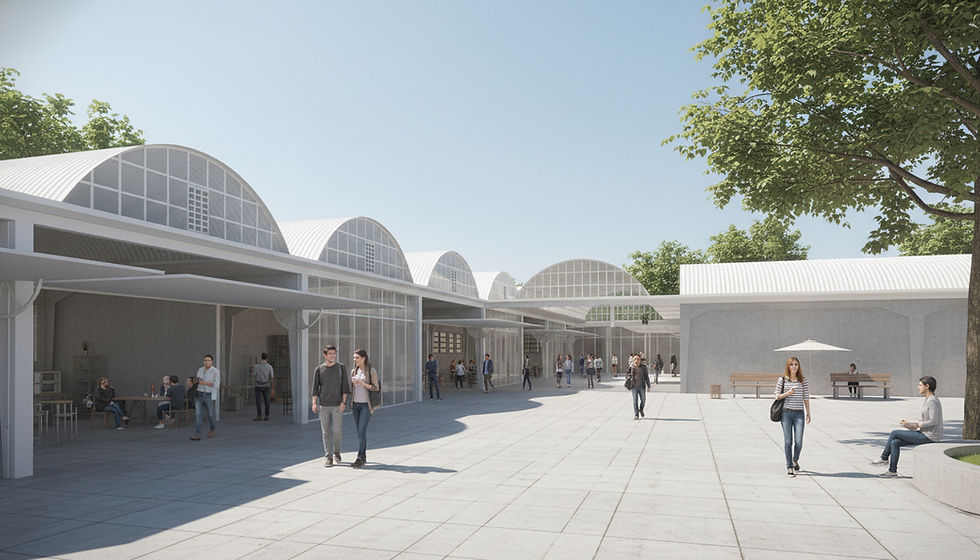
The new design preserves the original concrete structure, grid, and modular system, while adding creative studios, galleries, and public spaces as an extension of an arts school. Through subtraction and addition, an intimate inner courtyard is formed, with solid concrete volumes and semi-transparent facades. A lightweight envelope with natural light openings, an outdoor amphitheater, cafes, and dynamic accordion walls brings new life to the site.
Adaptive Reuse Studio, guided by Architect Gil Even-Tzur , 3rd Year

The Shaan Harod Cooperative is located in a rural area that reflects the history and evolution of kibbutz settlement. Positioned at the junction leading to Ein Harod and Tel Yosef, it lies between Beit Shean and Afula in the Harod Valley, at the foot of the Gilboa mountains. Founded in 1942 as a transportation branch in Kibbutz Beit HaShita, it became a cooperative in 1947, serving to transport agricultural produce across the region. At its peak, it included 24 settlements and nearly 100 vehicles. As it grew, a large central garage was required, and after considering several sites, the cooperative chose the main junction connecting the Beit Shean–Afula road with the access route to the kibbutzim.


In 1949, the planning work was assigned to architect Shmuel Bickels, an expert in the design of kibbutzim, public buildings, and agricultural facilities. He prepared dozens of sketches over roughly six months, from which the final plan was formulated. Immediately after completion of the main building, sheds, offices, and service structures were added to the site.
The severe recession into which the kibbutzim and agricultural settlement as a whole had fallen led to a crisis in the cooperative. By 2010, the kibbutzim no longer found meaningful value in their partnership in the company, and given their poor economic situation, they sold their shares. Today, the cooperative’s garages stand abandoned.


For the first time, the project enables the creation of a place that offers equal opportunities within a context that maintains a sense of integration. The new building functions as an extension of an arts school, combining private studio spaces with public areas for community use. Its modular structure allows spaces to expand as needed, with some areas serving as galleries and exhibition spaces. The design draws from the original garage form and from the greenhouse typology characteristic of the agricultural valley.
The original structural grid is preserved, and new volumes are added to create a more intimate inner courtyard, protected from the adjacent road. The internal buildings reinforce this sense of enclosure through their solid concrete presence, while the outer buildings introduce a unified, semi-transparent facade that reveals depth and activity within.


Although the transformation and redesign of the site is small, it is significant. Based on the existing structure, the module, and the drainage detail, a new envelope made of a lightweight structure, opaque glass, concrete, and natural light openings will be added.
A covered passageway will overlook the inner courtyard. In the public outer courtyard, an amphitheater for performances and various events will be created, with cafes adjacent to it for public use, overlooking the campus.
The interior spaces are built with concrete roofs featuring dispersed light openings, connecting to the original concrete structure and intended for lectures and exhibitions. The exterior spaces also connect to the original concrete structure through a roof and facades made of steel and channel glass, allowing full natural light to enter the workspaces. The internal partition walls will be dynamic, made of wooden accordion doors, enabling the expansion of the spaces.