LYMPH Building
2022
The project integrates a medical studies campus with an emergency triage center in the heart of Tel Aviv.
The building, formerly used as the headquarters of Mekorot and now slated for demolition, is preserved in its original structural form, while the interior spaces and their functions are entirely redesigned. The new addition is based on the existing structural grid and mediates between the low-rise urban fabric to the west and the high-rise towers to the east. The project explores a model in which an academic campus and a triage facility operate together within the urban fabric, addressing the need for flexible buildings in the post–COVID-19 era. The structure can be converted for epidemic-related hospitalization during emergencies while maintaining student housing and daily activity. Its proximity to the future light rail station and the Ayalon Road ensures excellent accessibility.
Complex Architectural System Studio, guided by Architect Osnat Tadmor , 2nd Year

The original Mekorot building, constructed in 1962 and serving as the company’s main headquarters, is located on Lincoln Street and forms part of the Kiriyat Sefer complex — a heterogeneous urban fabric that combines industrial structures, parking facilities, offices, and limited residential use on its western edge, alongside an ecological park in the heart of the city. The façade facing Lincoln Street was designed as an active commercial frontage, including a supermarket and restaurants, revealing the building’s internal modular grid to the public realm.
The building’s design was based on a vehicle-derived module, originating from the two-story parking structure (levels 2–3) incorporated into its southern side. This module established a fixed grid that defined the building’s structural system and its rational, functional character. Over time, parts of the building were converted from offices into residential units, but the structure is now slated for demolition to make way for a new residential and office tower.

![mekurot-diagram-[Converted]-01.gif](https://static.wixstatic.com/media/63b0fc_1807b9e5b0f34a8dbaa3da4f1c69cfe4~mv2.gif/v1/fill/w_980,h_677,al_c,usm_0.66_1.00_0.01,pstr/mekurot-diagram-%5BConverted%5D-01_gif.gif)


One of the key insights that emerged from the research is that the building itself operates as a continuous internal system functioning 24/7, enabled by its layered programmatic composition — housing, offices, commerce, and infrastructure — which generates a shifting sequence of uses and occupancies throughout the day.
The entire complex is integrated into an intensive circulation network: a system of multiple entrances and exits, pedestrian routes, bicycle paths, nearby bus stops, and the future light rail station, all operating in close synchrony. Its position at a major urban junction creates a peripheral and circular pattern of movement and activity, in which each function reinforces the others, producing an active, dynamic, and multi-layered environment at all hours of the day.


For a pedestrian moving through the site, the shift between its two parts creates an abrupt change in experience.
The eastern, commercial side functions as the “backyard” of the surrounding buildings: a space oriented mainly toward vehicles, with almost no sidewalks, dominated by logistics, loading and unloading, and truck movement. In contrast, the western side offers a complete dissonance — an open ecological park created through a residents' struggle to change the land-use designation. The park includes lawns, bicycle paths, ecological pools, and playgrounds, providing a green, continuous, and accessible environment for pedestrians and cyclists.


The design proposes a hybrid model in which an academic institution for medical education and an emergency care center operate within the urban fabric of Tel Aviv, rather than on the city’s periphery as is commonly the case. The building’s location at the transition zone between the low-rise fabric of the western “White City” and the eastern high-rise district informed an architectural addition that maintains urban continuity. In light of the challenges revealed by the COVID-19 pandemic and the need for adaptable medical infrastructures, the building is designed to function in a dual mode: in routine it operates as an active academic campus, while in emergencies it can be rapidly converted into a pandemic-care facility. In this way, it serves as a complementary medical infrastructure for central Israel’s hospitals, enabling an efficient urban response to extreme scenarios.


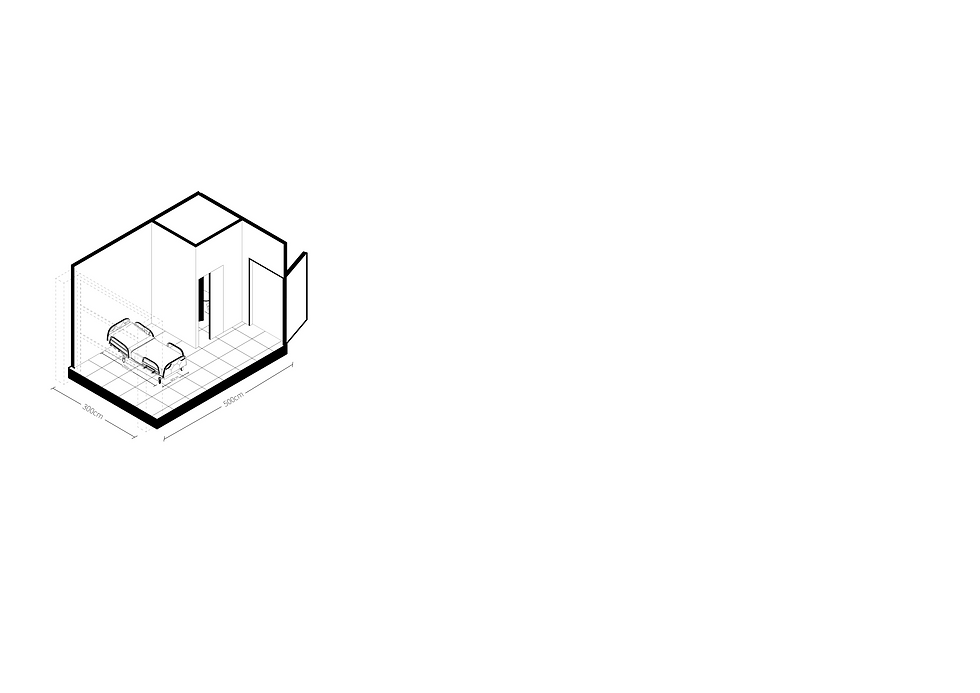
In contrast to the original design, which was based on a vehicular module due to the integrated parking structure, the new building is organized according to the dimensions of a hospital bed module, generating a range of medical spatial typologies. A dedicated storage floor equipped with emergency supplies enables the rapid expansion of inpatient capacity during pandemics, ensuring that the building can adapt to extreme scenarios without disrupting its daily operation.

The building houses a comprehensive medical program that includes an emergency department, an ambulance station, treatment and inpatient rooms, operating theaters, and outpatient clinics, alongside para-medical facilities such as a hydrotherapy center with a swimming pool, a gym, and physiotherapy spaces. The floor layouts incorporate patios within the inpatient and residential levels and along the sloped roofs, bringing natural light into the interior and creating optimal conditions for patients, students, and staff.
As a medical teaching campus, the building includes classrooms, a library, an auditorium, and observation galleries positioned above the operating rooms for educational use. Students also reside on-site, forming an active academic-medical community throughout the day.


